


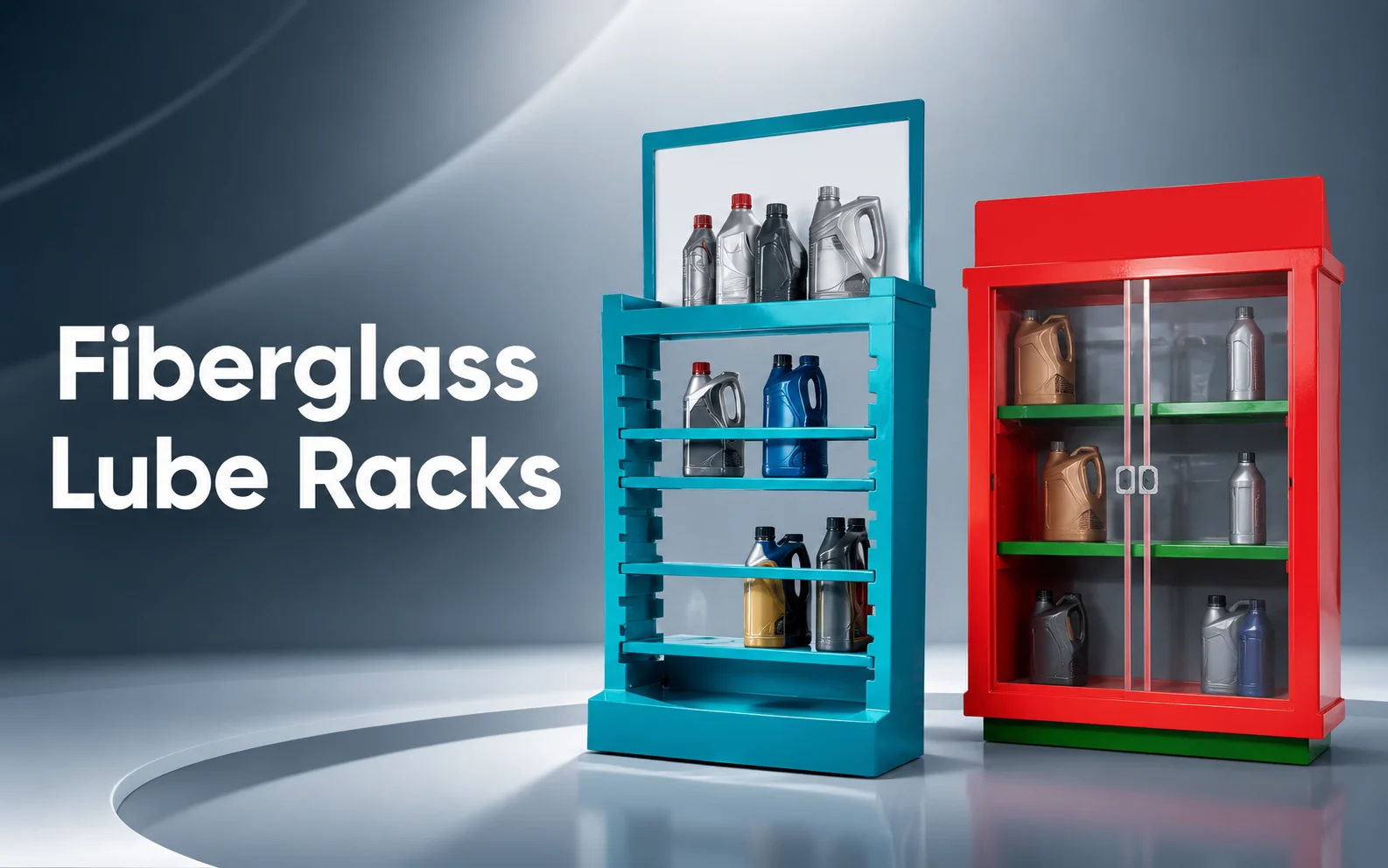
Fiberglass Lube Rack for Gas Stations: Durable Engine Oil Display Solution
A well-designed fiberglass lube rack gives gas stations, petrol pumps, service stations, and oil change shops a practical way to display engine oils and lubricants where customers can see them easily. Unlike an ordinary indoor shelving unit, a rack used at a filling station may face dust, moisture, sunlight, temperature changes, oil stains, and frequent handling every day.
That operating environment makes material selection important.
Fiberglass, also known as fiberglass-reinforced plastic or FRP, combines reinforcing glass fibers with a resin system to create a strong, lightweight, and corrosion-resistant composite material. When the rack is properly designed and manufactured for outdoor service, fiberglass can provide an attractive alternative to conventional steel, wood, and basic plastic displays.
A fiberglass oil display rack can also be customized around lubricant bottle sizes, available floor space, brand colors, logos, shelf configuration, and the visual identity of a petrol station.
This guide explains what fiberglass lube racks are, their main advantages, common applications, material comparisons, purchasing considerations, customization options, and the factors that determine long-term value.
What Is a Fiberglass Lube Rack?
A fiberglass lube rack is a purpose-built shelving or merchandising unit made primarily from fiberglass composite materials. It is designed to hold and display packaged lubricants such as motor oil, transmission fluid, brake fluid, coolant, gear oil, and related automotive products.
Depending on the design, a lube oil display rack may be installed:
- Near a petrol pump forecourt
- Beside an oil change bay
- Outside a convenience store
- Inside a lubricant shop
- Near a service station reception area
- In an automotive workshop
- At a branded engine oil sales point
The basic purpose is simple: organize lubricant products and make them visible and accessible without allowing the display itself to become untidy or difficult to maintain.
Common Design Features
A practical fiberglass rack may include:
- Two, three, four, or more product shelves
- Raised shelf edges to help keep containers in position
- A molded top header for branding
- Side panels for logos and promotional graphics
- Smooth surfaces for easier cleaning
- Reinforced sections where higher loads are expected
- An elevated base to reduce direct contact with standing water
- Optional internal steel reinforcement where the design requires it
- Mounting or anchoring provisions for outdoor installations
The exact construction should always match the required dimensions, product weight, installation location, and expected service conditions.
Top Benefits of a Fiberglass Lube Rack
1. Excellent Resistance to Corrosion
One of the most useful characteristics of fiberglass is that it does not rust like ordinary carbon steel.
Gas stations and service areas can be exposed to rainwater, washing, humidity, road dirt, oils, and cleaning chemicals. A steel rack can perform very well when it has the correct coating, but damaged paint or coating may eventually expose the metal underneath.
Fiberglass avoids conventional metal rust, making it particularly useful where moisture and outdoor exposure are important considerations.
2. Suitable for Outdoor Display
A properly manufactured outdoor fiberglass lubricant display rack can handle demanding weather conditions better than many indoor furniture materials.
For outdoor service, however, the fiberglass specification matters. UV-resistant resin systems, suitable gel coats, pigments, surface finishes, drainage details, and adequate wall thickness all contribute to long-term performance.
Fiberglass should not simply be described as permanently weatherproof regardless of construction. Outdoor durability depends on the quality of the laminate and protective surface system.
3. Lower Weight Than Many Metal Structures
Fiberglass products can provide useful strength without the weight associated with heavy steel construction.
A lighter fiberglass motor oil display stand can make handling, installation, repositioning, and transport more convenient. The rack still needs sufficient structural strength and a stable base, especially when it will hold many lubricant bottles.
4. Easy-to-Clean Surfaces
Engine oil displays can quickly collect dust, fingerprints, oil residue, and general forecourt dirt.
Smooth fiberglass surfaces are relatively easy to wipe and wash when compatible cleaning products are used. Rounded corners and molded surfaces can also reduce the number of difficult-to-clean joints compared with some fabricated shelving systems.
5. Flexible Shapes and Branding
Fiberglass is particularly useful for custom-shaped products.
A manufacturer can create a lubricant display rack with curved panels, molded branding areas, raised sections, decorative side profiles, and other features that may be difficult or expensive to produce with conventional flat-sheet materials.
Color can also be incorporated into the surface finish, while logos, vinyl graphics, decals, or separate branding panels can be added according to the customer’s merchandising requirements.
6. Professional Product Presentation
A lubricant display is not only storage equipment. It is part of the customer’s visual experience.
Keeping bottles arranged by viscosity, product type, pack size, or brand helps customers identify products quickly. A clean, purpose-built engine oil display rack can make the retail area look more organized than oil containers stacked on counters, floors, or improvised shelves.
How Fiberglass Lube Racks Compare to Other Materials
Choosing the right material depends on location, budget, design, and maintenance requirements.
| Material | Main Advantages | Important Considerations |
|---|---|---|
| Fiberglass/FRP | Corrosion-resistant, lightweight, customizable, suitable for outdoor designs | Quality of resin, laminate, reinforcement, UV protection, and workmanship matters |
| Painted Steel | High strength, familiar fabrication process, good load capacity | Coating damage can lead to corrosion and periodic repainting may be required |
| Stainless Steel | Strong and highly corrosion-resistant in many environments | Usually more expensive and offers different styling possibilities than molded fiberglass |
| Wood/MDF | Economical for many indoor displays and easy to fabricate | Generally less suitable for repeated moisture or outdoor exposure |
| Basic Plastic | Lightweight and economical | Large displays may require additional reinforcement and design choices may be limited |
For a gas station that needs a durable, branded outdoor display, fiberglass often provides a useful balance between appearance, weight, corrosion resistance, and customization.
The best choice still depends on the actual project. A heavily loaded industrial shelf, for example, may require a different structural solution from a merchandising rack holding one-liter motor oil containers.
Best Applications and Use Cases
A custom gas station oil display rack can be useful wherever packaged automotive fluids need to remain organized and highly visible.
Common applications include:
- Petrol pumps: Display popular engine oils close to the fueling or sales area.
- Service stations: Organize oils, coolants, brake fluids, and other maintenance products.
- Oil change shops: Keep frequently used lubricant grades visible and accessible.
- Automotive workshops: Separate different oil types and package sizes.
- Lubricant distributors: Create branded displays for retail dealers.
- Convenience stores: Provide a dedicated automotive-product display near suitable sales areas.
- Promotional campaigns: Manufacture branded racks for a new lubricant range or dealer network.
A rack can also be designed for a specific product family so different bottle sizes sit neatly rather than leaving excessive empty space.
Cost vs. Value of a Fiberglass Lube Rack
The lowest purchase price does not always mean the lowest long-term cost.
A simple wooden, plastic, or lightly fabricated steel rack may initially cost less than a custom fiberglass design. However, the calculation changes when outdoor exposure, corrosion, repainting, replacement frequency, cleaning, branding, and presentation are considered.
The price of a fiberglass rack is normally influenced by factors such as:
- Overall dimensions
- Number and depth of shelves
- Required load capacity
- Fiberglass laminate thickness
- Resin and gel-coat specification
- Reinforcement requirements
- Mold complexity
- Surface finish
- Brand colors and graphics
- Quantity ordered
- Packaging and transportation
- Installation or anchoring requirements
For multi-site petrol station operators or lubricant companies, repeat production from an established design can also help maintain a consistent appearance across different locations.
Value should therefore be evaluated over the expected working life of the rack rather than by initial cost alone.
Tips for Choosing a Fiberglass Lube Rack for a Gas Station
1. Define the Products First
List the bottle sizes and quantities the rack must hold. One-liter bottles require a different shelf arrangement from four-liter or five-liter containers.
2. Specify the Required Load Capacity
A shelf containing dozens of oil bottles can carry considerable weight. Ask the manufacturer to design the shelving and reinforcement around the intended load instead of relying only on external dimensions.
3. Measure the Installation Area
Check:
- Available width
- Overall height
- Shelf depth
- Pedestrian clearance
- Distance from doors and equipment
- Visibility from customer areas
- Space required for cleaning
Accurate measurements reduce the risk of receiving a rack that is attractive but unsuitable for the actual site.
4. Ask About Outdoor Material Specification
For an outdoor fiberglass lube rack, discuss UV exposure, rain, heat, surface finish, resin system, gel coat, pigments, and drainage with the manufacturer.
Outdoor Installation Details Matter
A durable material still needs sensible installation. The rack should stand securely, avoid trapping water where possible, and be anchored when site conditions or rack geometry require it.
5. Choose a Practical Shelf Layout
Do not focus only on appearance. Employees need to replenish products quickly, customers need to see labels, and bottles should have adequate support.
A small retaining lip can also help reduce accidental movement of containers, depending on the shelf design.
6. Plan Branding Before Manufacturing
If the rack will promote a lubricant brand, decide early where the following elements will appear:
- Logo
- Product name
- Brand colors
- Promotional message
- Product-category labels
- Header graphics
Integrating these elements into the original design usually produces a cleaner result than adding them after manufacturing.
7. Consider Petrol Station Safety Requirements
Fiberglass has many useful properties, but an ordinary fiberglass product should not automatically be described as fireproof.
Resin formulations have different fire-performance characteristics. Any rack installed at a filling station should comply with applicable site rules, fire-safety requirements, access restrictions, emergency routes, and instructions from the petrol station operator or relevant authority.
The display must never obstruct emergency equipment, exits, walkways, or essential operating areas.
8. Work With an Experienced Fabricator
A well-made fiberglass product depends on laminate quality, reinforcement, surface finishing, molding, dimensional control, and proper curing—not simply on using the word “fiberglass.”
Discuss drawings, dimensions, load requirements, outdoor exposure, colors, branding, quantity, and installation conditions before approving production.
Custom Fiberglass Lube Racks for Engine Oil Brands
Customization is one of the strongest reasons to consider fiberglass for lubricant merchandising.
A custom rack can be manufactured around the visual identity of an engine oil company instead of forcing the brand to adapt to a standard metal shelf.
Possible customization options include:
- Custom height, width, and depth
- Different shelf quantities and spacing
- Brand-specific colors
- Molded or applied logos
- Curved or straight side panels
- Large top advertising headers
- Product separators
- Reinforced shelves
- Single-sided or double-sided configurations
- Indoor or outdoor specifications
INDUSTRIAL TECHNO INTERNATIONAL, based in Lahore, Pakistan, provides fiberglass fabrication services and can manufacture customized fiberglass products according to project requirements.
For a custom fiberglass oil display rack, customers should provide the required dimensions, expected product load, preferred design, site conditions, branding details, and quantity so the rack can be developed around its actual application.
Manufacturer: INDUSTRIAL TECHNO INTERNATIONAL
Location: Lahore, Pakistan
Phone: +92 300 8433290
Website: www.itipk.com
Frequently Asked Questions About Fiberglass Lube Racks
What is the difference between fiberglass and FRP?
FRP means fiber-reinforced plastic or fiber-reinforced polymer. Fiberglass products are a common form of FRP in which glass fibers reinforce a resin matrix.
Can a fiberglass lube rack be used outdoors?
Yes, fiberglass can be well suited to outdoor applications when the product is manufactured with an appropriate resin system, surface finish, UV protection, structural design, and installation method.
Does a fiberglass oil display rack rust?
Fiberglass itself does not develop conventional iron rust because it is not steel. If a rack contains steel reinforcement, fasteners, or fittings, those metal components should be selected or protected appropriately for the intended environment.
Can fiberglass racks carry heavy oil bottles?
They can be designed for substantial loads, but capacity depends on shelf dimensions, laminate thickness, reinforcement, span, construction method, and overall design. The required load should be specified before manufacturing.
Can the rack be made in lubricant brand colors?
Yes. Fiberglass products can be manufactured with colored surface finishes and can also accommodate decals, logos, graphics, and branded panels.
Is a fiberglass lube rack fireproof?
Not necessarily. Standard fiberglass composites should not automatically be classified as fireproof. Fire-retardant resin systems are available for applications requiring specific fire-performance characteristics, but the appropriate specification should be confirmed for the project and local requirements.
How should a fiberglass lube rack be cleaned?
For ordinary dirt and oil residue, use water and a mild compatible detergent with a soft cloth or sponge. Avoid aggressive solvents or abrasive cleaning methods unless the manufacturer confirms that they are suitable for the surface finish.
What size lube rack is best for a petrol pump?
There is no universal best size. The correct dimensions depend on available space, number of products, bottle sizes, customer traffic, required inventory, branding area, and installation location. A custom design is often more practical when space is limited or a specific product range must be displayed.
Conclusion
A fiberglass lube rack is a practical engine oil display solution for gas stations, petrol pumps, service stations, lubricant shops, and automotive workshops that need durability, organized merchandising, and flexible branding.
Its main advantages include resistance to rust, relatively low weight, easy-to-clean surfaces, outdoor design potential, and the ability to create custom shapes and brand-specific displays. However, good performance depends on proper engineering. Resin quality, UV protection, shelf loading, reinforcement, stability, anchoring, and site safety should all be considered before manufacturing.
Compared with an ordinary display shelf, a purpose-built lubricant display rack can provide better product organization and a more professional appearance while being designed specifically for the conditions found at automotive retail locations.
For businesses seeking a customized engine oil display rack or fiberglass motor oil display stand, INDUSTRIAL TECHNO INTERNATIONAL in Lahore, Pakistan can be contacted to discuss dimensions, product capacity, branding, design, and project-specific requirements.

