

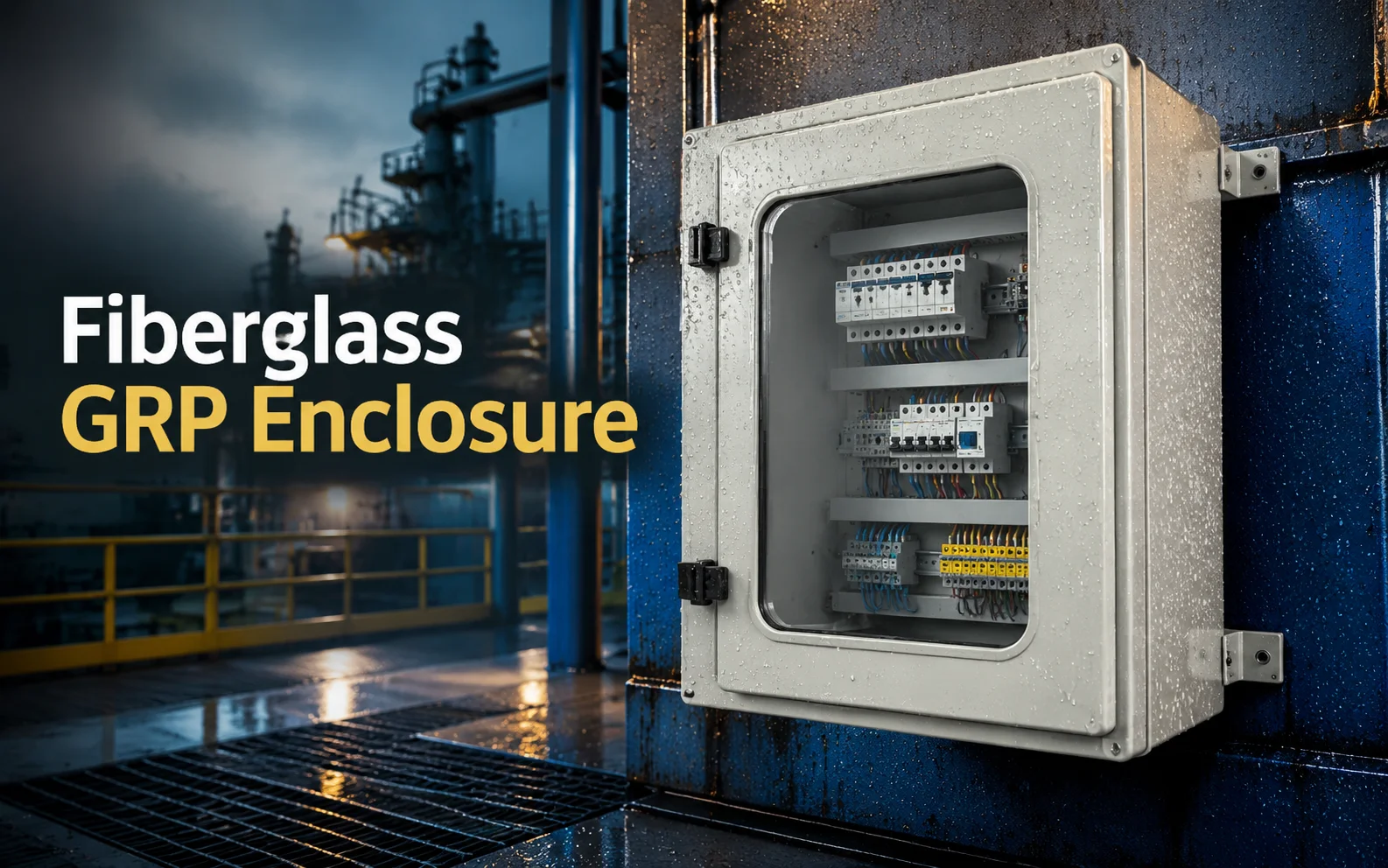
Fiberglass GRP Enclosure: IP55 Industrial Protection
Explore IP55 fiberglass GRP enclosures for indoor and outdoor industrial use with corrosion resistance, secure sealing, durable hardware, and flexible mounting. Industrial electrical and control equipment often operates in conditions that are far less forgiving than a clean office or server room. Dust, moisture, chemicals, humidity, sunlight, temperature changes, accidental contact, and corrosive air can gradually damage sensitive components if they are not protected by the right enclosure.
A Fiberglass GRP Enclosure provides a practical solution for protecting electrical, electronic, telecom, automation, instrumentation, and control equipment in both indoor and outdoor installations. GRP combines glass-fiber reinforcement with a polymer resin system to create a strong, corrosion-resistant enclosure that does not rust like ordinary steel.
For industrial environments where corrosion, electrical insulation, weather exposure, and long service life are important considerations, GRP has become a widely used enclosure material. Established enclosure manufacturers offer fiberglass-reinforced polyester products specifically for demanding indoor and outdoor environments, including corrosive applications.
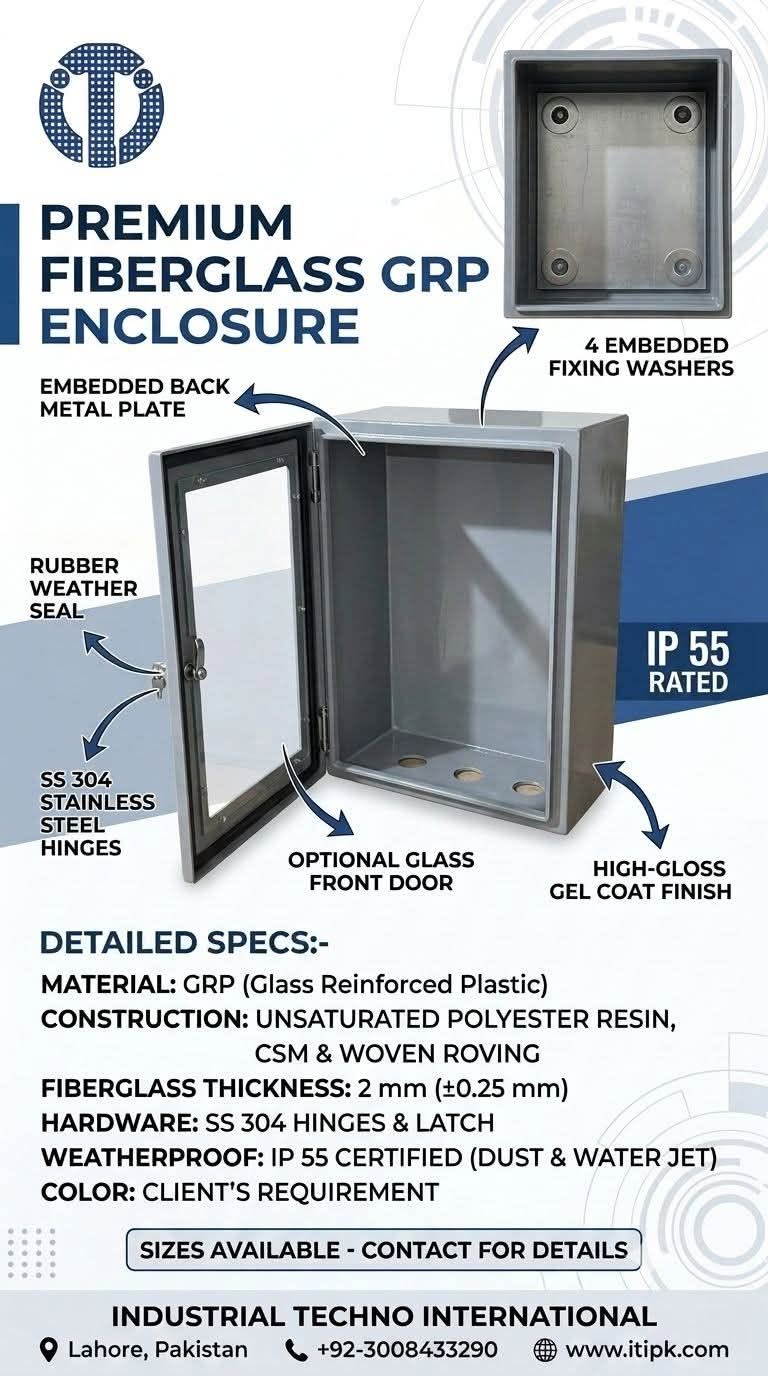
At INDUSTRIAL TECHNO INTERNATIONAL, the IP55 GRP Enclosure is designed using unsaturated polyester resin reinforced with CSM and woven roving fiberglass, together with stainless-steel hardware, a weatherproof gasket system, an internal mounting plate, and a protective gel-coat finish.
This guide explains what GRP enclosures are, how GRP cabinets and kiosks differ, why industries choose fiberglass, where these products can be installed, and what buyers should consider before selecting an enclosure.
What Is an Enclosure?
An enclosure is a protective housing used to isolate electrical, electronic, mechanical, communication, or control equipment from its surrounding environment.
Inside a typical industrial enclosure, you may find:
- Circuit breakers
- Electrical terminals
- Relays and contactors
- PLC equipment
- Power supplies
- Telecom equipment
- Fiber-optic components
- Network switches
- Sensors and monitoring systems
- Control devices
- Metering equipment
- Automation components
Without proper protection, these components may be exposed to dust, moisture, physical contact, corrosive substances, insects, and other contaminants.
The enclosure therefore becomes an important part of the complete installation rather than simply a box around the equipment.
What Is a Fiberglass GRP Enclosure?
GRP stands for Glass Reinforced Plastic, also commonly called fiberglass-reinforced plastic or fiberglass-reinforced polyester when polyester resin is used.
A Fiberglass GRP Enclosure is manufactured by combining a polymer resin with glass-fiber reinforcement. The resin forms the surrounding matrix, while the glass fibers strengthen the structure.
The result is a composite material that provides several useful industrial characteristics, particularly corrosion resistance, low electrical conductivity compared with metal enclosures, structural strength, and suitability for demanding environmental conditions.
Commercial fiberglass-reinforced polyester enclosures are widely offered for corrosive and outdoor environments, confirming GRP’s established role as an industrial enclosure material.
What Are GRP Cabinets, Kiosks and Enclosures?
Although the terms are sometimes used interchangeably, GRP enclosures, GRP cabinets, and GRP kiosks normally refer to different enclosure formats.
GRP Enclosures
A GRP enclosure is generally a compact or medium-sized protective housing intended for electrical, telecom, instrumentation, or control equipment.
It may be:
- Wall-mounted
- Pole-mounted
- Structure-mounted
- Installed on machinery
- Installed inside an electrical room
- Installed outdoors
Enclosures are commonly used for distribution equipment, terminals, monitoring devices, communication equipment, junction systems, and automation components.
GRP Cabinets
A GRP cabinet is generally larger than a basic enclosure and provides additional internal space for equipment.
GRP electrical cabinets may contain several devices, mounting plates, DIN rails, breakers, control equipment, telecom hardware, meters, batteries, or monitoring equipment.
Cabinets are especially useful when technicians require easier access for installation, inspection, modification, and maintenance.
GRP Kiosks
A GRP kiosk is normally a larger freestanding structure designed to house complete electrical, telecom, utility, control, or instrumentation systems.
Depending on the design, a GRP kiosk may accommodate:
- Distribution panels
- Metering equipment
- Telecom systems
- Control panels
- Industrial automation equipment
- Utility equipment
- Monitoring systems
- Network infrastructure
The correct choice between an enclosure, cabinet, and kiosk depends mainly on equipment size, access requirements, installation location, ventilation requirements, cable routing, and the required environmental protection.
Top Benefits of a Fiberglass GRP Enclosure
The popularity of fiberglass enclosures comes from a combination of physical and operational advantages rather than one single feature.
1. Excellent Corrosion Resistance
One of the strongest reasons for choosing GRP is corrosion resistance.
Traditional painted steel can eventually become vulnerable if coatings are scratched, damaged, incorrectly maintained, or continuously exposed to moisture and aggressive environments. GRP itself does not rust like ferrous metal.
This makes corrosion-resistant GRP enclosures particularly useful in locations where moisture, humidity, chemical fumes, industrial pollution, or outdoor exposure may be present.
GRP enclosure products from major industrial manufacturers are specifically promoted for corrosive environments and indoor/outdoor applications.
2. Electrical Insulation Characteristics
GRP is a non-metallic composite and provides electrical insulation characteristics that can be advantageous around electrical equipment.
This does not mean that an enclosure automatically makes every electrical installation safe. Correct internal design, cable glands, wiring, protection devices, bonding requirements for internal metallic components, and installation practices still matter.
However, the non-metallic enclosure body can reduce some concerns associated with an exposed conductive metal housing.
3. Strong Fiberglass-Reinforced Construction
Fiberglass reinforcement improves the mechanical performance of the resin system.
The INDUSTRIAL TECHNO INTERNATIONAL IP55 GRP Enclosure uses:
Unsaturated Polyester Resin + CSM + Woven Roving GRP
CSM, or chopped strand mat, provides glass-fiber reinforcement distributed through the composite structure, while woven roving uses woven glass fibers to provide additional reinforcement.
Combining appropriate resin and fiberglass reinforcement allows the enclosure body to achieve useful strength without relying entirely on a metal shell.
4. Lower Corrosion Maintenance
A conventional metal enclosure may require attention to damaged paint, exposed metal, corrosion points, and surface deterioration.
Because fiberglass does not rust in the same manner as carbon steel, maintenance associated specifically with rust prevention can be reduced.
That can be valuable at remote sites where every inspection or maintenance visit has a cost.
5. Suitable for Indoor and Outdoor Installations
A properly designed GRP enclosure can be used in both indoor and outdoor environments when its complete construction, finish, gasket, hardware, cable entries, and protection rating are suitable for the application.
The ITI enclosure uses an outside gel coat and inside top coat. The exterior surface system provides a finished protective layer, while custom colors can be supplied according to project requirements.
For outdoor projects, engineers should still evaluate site-specific conditions such as continuous sunlight, ambient temperature, chemical exposure, water direction, mounting orientation, and cable entry design.
6. Stainless-Steel Hardware
Hardware is often overlooked when choosing an enclosure.
The ITI IP55 GRP enclosure uses:
- SS304 stainless-steel hinges
- High-tension latch
Using corrosion-resistant hardware supports the overall durability of the enclosure, particularly where ordinary steel fittings could become a weak point.
Understanding the IP55 GRP Enclosure Rating
One of the most important specifications of this enclosure is IP55.
IP ratings are defined under IEC 60529, the international standard covering degrees of protection provided by electrical equipment enclosures.
The two digits should be understood separately.
What Does the First “5” Mean?
The first digit relates to protection against access and solid foreign objects.
A first digit of 5 means the enclosure is dust-protected.
It is important to use the correct terminology: IP5X is not the same as completely dust-tight. Complete dust-tight protection corresponds to a first digit of 6.
What Does the Second “5” Mean?
The second digit describes protection against water.
A rating of IPX5 provides protection against water jets directed toward the enclosure under the defined test conditions.
Therefore, an IP55 GRP Enclosure provides a useful level of protection against dust and water jets.
However, IP55 should not be described as waterproof under every possible condition. It does not mean the enclosure can be submerged in water.
Correct installation remains essential. Poorly installed cable glands, incorrectly drilled holes, damaged seals, or an improperly closed door can compromise the protection of an otherwise correctly designed enclosure.
IP55 GRP Enclosure Key Features
The INDUSTRIAL TECHNO INTERNATIONAL model is specified with the following construction:
Material
Unsaturated Polyester Resin + CSM & Woven Roving GRP
This composite construction combines polyester resin with glass-fiber reinforcement to create the main enclosure structure.
Thickness
2 mm ± 0.25 mm
Wall thickness is controlled within the stated tolerance. Actual suitability should always be considered together with enclosure size, mounting arrangement, equipment weight, and mechanical loading.
Ingress Protection
IP55 – Dust & Water Jet Protection
The IP55 specification is intended to protect installed equipment against the environmental conditions represented by this ingress-protection level.
Hardware
SS304 Stainless-Steel Hinges & High-Tension Latch
Stainless-steel hardware helps support dependable operation and corrosion resistance.
Mounting System
Embedded Back Metal Plate + 4 Integrated Fixing Washers
The internal metal mounting plate provides a practical surface for installing electrical and control equipment, while the fixing arrangement supports secure enclosure installation.
Sealing System
Weatherproof Rubber Gasket
A properly fitted gasket helps maintain the seal between the enclosure body and door.
Surface Finish
Outside Gel Coat | Inside Top Coat
Custom colors are available for projects requiring specific equipment identification, site standards, or visual integration.
Optional Glass Front Door
A glass front door option can be useful when operators need to view meters, indicators, displays, controllers, or internal equipment without routinely opening the enclosure.
Why Do Industrial Companies Use GRP Enclosures?
Industrial users choose enclosure materials according to the environment rather than simply selecting the strongest-looking box.
GRP is frequently considered where the installation presents challenges such as:
- Outdoor exposure
- High humidity
- Corrosive surroundings
- Industrial pollution
- Utility installations
- Frequent temperature changes
- Electrical insulation requirements
- Difficult maintenance access
- Long-term exposure to moisture
Major industrial enclosure manufacturers offer fiberglass-reinforced polyester ranges alongside steel and stainless-steel products because no single enclosure material is ideal for every application.
GRP fills an important gap where users require a durable non-metallic enclosure with strong corrosion resistance.
Fiberglass Enclosure for Indoor and Outdoor Installations
Indoor Applications
An industrial fiberglass enclosure is useful indoors wherever electrical or electronic components need protection against dust, moisture, accidental contact, or corrosive environments.
Typical indoor locations include:
- Factories
- Production areas
- Pump rooms
- Warehouses
- Utility buildings
- Electrical rooms
- Industrial plants
- Water-treatment facilities
- Workshops
- Process facilities
GRP can be especially valuable indoors where humidity or chemical exposure makes ordinary painted steel less attractive.
Outdoor Applications
Outdoor installations expose enclosures to more variables.
Depending on the site, an enclosure may face:
- Rain
- Dust
- Wind
- Humidity
- Sunlight
- Pollution
- Temperature cycling
- Insects
- Accidental impact
- Water from cleaning or maintenance
A correctly selected outdoor GRP enclosure can provide a practical protective housing for electrical and communication equipment.
However, the IP rating and material must always be matched to actual conditions. An IP55 enclosure should not be selected for an application requiring permanent immersion or a higher level of ingress protection.
Best Applications and Use Cases
Fiberglass GRP enclosures can support many industries and infrastructure projects.
Electrical Distribution
GRP enclosures can house breakers, terminals, protection devices, meters, and distribution components.
Telecom and Networking
Telecom installations often require protected spaces for switches, communication equipment, fiber systems, terminals, converters, and monitoring devices.
Solar and Renewable Energy
Outdoor renewable-energy installations may require enclosures for control equipment, monitoring devices, protection systems, and electrical connections.
Water and Wastewater Projects
High humidity and continuously damp surroundings can make corrosion resistance particularly valuable around pumps, treatment equipment, monitoring systems, and control infrastructure.
Industrial Automation
PLC components, relays, instrumentation, terminals, and control devices often require protection from factory dust and moisture.
Utility Infrastructure
GRP cabinets and enclosures can be used for metering, monitoring, telecom, and electrical systems installed at utility sites.
Coastal and Humid Locations
Atmospheres with persistent moisture can accelerate deterioration of unsuitable metals and coatings. A properly specified corrosion-resistant enclosure can therefore provide a meaningful service-life advantage.
Fiberglass GRP Enclosure vs. Other Enclosure Materials
Choosing between GRP, painted steel, stainless steel, and other plastics requires considering the actual operating environment.
| Factor | GRP Fiberglass | Painted Steel | Stainless Steel |
|---|---|---|---|
| Rust resistance | Excellent | Depends heavily on coating condition | Excellent |
| Electrical conductivity of body | Low/non-metallic | Conductive | Conductive |
| Outdoor potential | Very good when correctly specified | Good with suitable coating | Very good |
| Weight | Generally lower than comparable metal construction | Higher | Higher |
| Maintenance against rust | Low | May require attention | Low |
| Corrosive environments | Strong option | Can be limited if coating is damaged | Strong option |
| Material cost | Application-dependent | Often lower initially | Often higher |
| Modification | Requires correct composite-working methods | Easy with metal tools | Requires appropriate tools |
No material wins every comparison.
Painted steel remains useful in many controlled environments. Stainless steel is highly durable and appropriate for severe applications. GRP becomes particularly attractive when corrosion resistance, non-metallic construction, and environmental protection are priorities.
Cost vs. Value: Is a GRP Enclosure Worth It?
Enclosure purchasing should not be based only on initial price.
A less expensive enclosure can become costly if corrosion, seal failure, water ingress, equipment damage, repainting, or premature replacement occurs.
A better way to evaluate value is to consider the total cost of ownership.
Ask:
- How long should the enclosure remain in service?
- Is the environment corrosive or humid?
- What is the value of the equipment inside?
- How expensive would equipment downtime be?
- How difficult is the installation location to access?
- Will corrosion maintenance be required?
- What ingress-protection rating is actually needed?
For installations where corrosion is a major risk, paying for an appropriately specified GRP enclosure may provide better long-term value than repeatedly repairing or replacing an unsuitable enclosure.
Tips for Choosing the Best Fiberglass GRP Enclosure
1. Select the Correct IP Rating
Do not choose an IP rating simply because a higher number sounds better.
Match the enclosure to dust, moisture, washdown, rain, and water-exposure conditions at the actual installation site.
2. Check the Required Internal Space
Allow enough room for equipment, wiring, terminals, cable bend radius, future maintenance, and safe separation between components.
3. Consider Equipment Weight
The enclosure wall, mounting plate, fasteners, and fixing points must support the installed equipment safely.
4. Review the Gasket and Door Design
Ingress protection depends on the complete sealing system, not just the enclosure material.
Inspect the gasket arrangement, latch, hinges, cable glands, and closing pressure.
5. Choose Appropriate Hardware
Stainless-steel hinges and reliable latching hardware are particularly useful where humidity and corrosion are concerns.
6. Plan Cable Entries Carefully
Every drilled opening can affect the enclosure’s protection.
Use correctly rated cable glands, plugs, and accessories, and install them according to their requirements.
7. Decide Whether Visibility Is Required
If technicians regularly need to read displays or meters, a glass front door can reduce unnecessary enclosure opening.
8. Consider Outdoor Environmental Conditions
For outdoor projects, evaluate sunlight, heat, rain direction, dust, wind, chemical exposure, mounting position, drainage, and site-specific environmental conditions.
Frequently Asked Questions About Fiberglass GRP Enclosures
What does GRP mean?
GRP means Glass Reinforced Plastic. It is a composite material combining a polymer resin with glass-fiber reinforcement.
Is fiberglass the same as GRP?
In enclosure applications, the terms are often used to describe closely related glass-fiber-reinforced composite materials. More precise terminology may identify the resin system, such as fiberglass-reinforced polyester.
What does IP55 mean?
IP55 means the enclosure is dust-protected and protected against water jets under the applicable IP test conditions. It does not mean the enclosure is completely dust-tight or suitable for immersion.
Can an IP55 GRP enclosure be installed outdoors?
It can be suitable for many outdoor installations when its complete design, finish, sealing system, cable entries, mounting method, and environmental conditions are appropriate.
The actual site should always be assessed before final selection.
Does a GRP enclosure rust?
The GRP enclosure body does not rust like ferrous steel because it is a fiberglass-reinforced polymer composite. Metallic accessories and internal components should still be selected according to environmental requirements.
Why are stainless-steel hinges useful?
Stainless-steel hardware provides better corrosion resistance than ordinary untreated steel hardware, helping avoid a situation where enclosure accessories deteriorate before the main GRP body.
What is the purpose of a gel-coat finish?
The exterior gel coat provides the finished outer surface of the GRP enclosure and helps protect the underlying composite. Exact environmental and UV performance depends on the specific formulation and application requirements.
Can electrical components be mounted directly inside the enclosure?
An internal mounting system is generally preferred. The ITI IP55 GRP Enclosure includes an embedded back metal plate, providing a practical mounting surface for electrical and control equipment.
Is a glass front door available?
Yes. A glass front door option is available where operators need visual access to indicators, meters, controllers, or other equipment.
What thickness is the ITI GRP enclosure?
The specified enclosure thickness is 2 mm with a tolerance of ±0.25 mm.
Suitability must still be evaluated according to enclosure dimensions, loading, installation method, and application requirements.
Conclusion: Why Choose a Fiberglass GRP Enclosure?
A Fiberglass GRP Enclosure offers an effective combination of corrosion resistance, non-metallic construction, fiberglass reinforcement, environmental protection, and long-term practicality.
For industrial users, the main advantage is not simply that fiberglass is different from steel. Its value becomes clear in applications where moisture, humidity, corrosive conditions, outdoor exposure, and electrical equipment protection must all be considered together.
The INDUSTRIAL TECHNO INTERNATIONAL IP55 GRP Enclosure is manufactured using unsaturated polyester resin reinforced with CSM and woven roving, with a nominal thickness of 2 mm ±0.25 mm. It incorporates SS304 stainless-steel hinges, a high-tension latch, weatherproof rubber gasket, embedded back metal mounting plate, four integrated fixing washers, outside gel coat, inside top coat, custom color options, and an optional glass front door.
Its IP55 rating provides dust protection and protection against water jets, making it suitable for many industrial indoor and outdoor applications when correctly selected and installed.
For electrical distribution, automation, telecom, utility, monitoring, control, industrial, and infrastructure projects where corrosion resistance and dependable equipment protection matter, a properly specified GRP enclosure can provide an excellent balance between durability, performance, maintenance requirements, and long-term value.
For technical specifications, sizes, customization, or project requirements, contact:
INDUSTRIAL TECHNO INTERNATIONAL
📍 Lahore, Pakistan
📞 +92 300 8433290
🌐 www.itipk.com
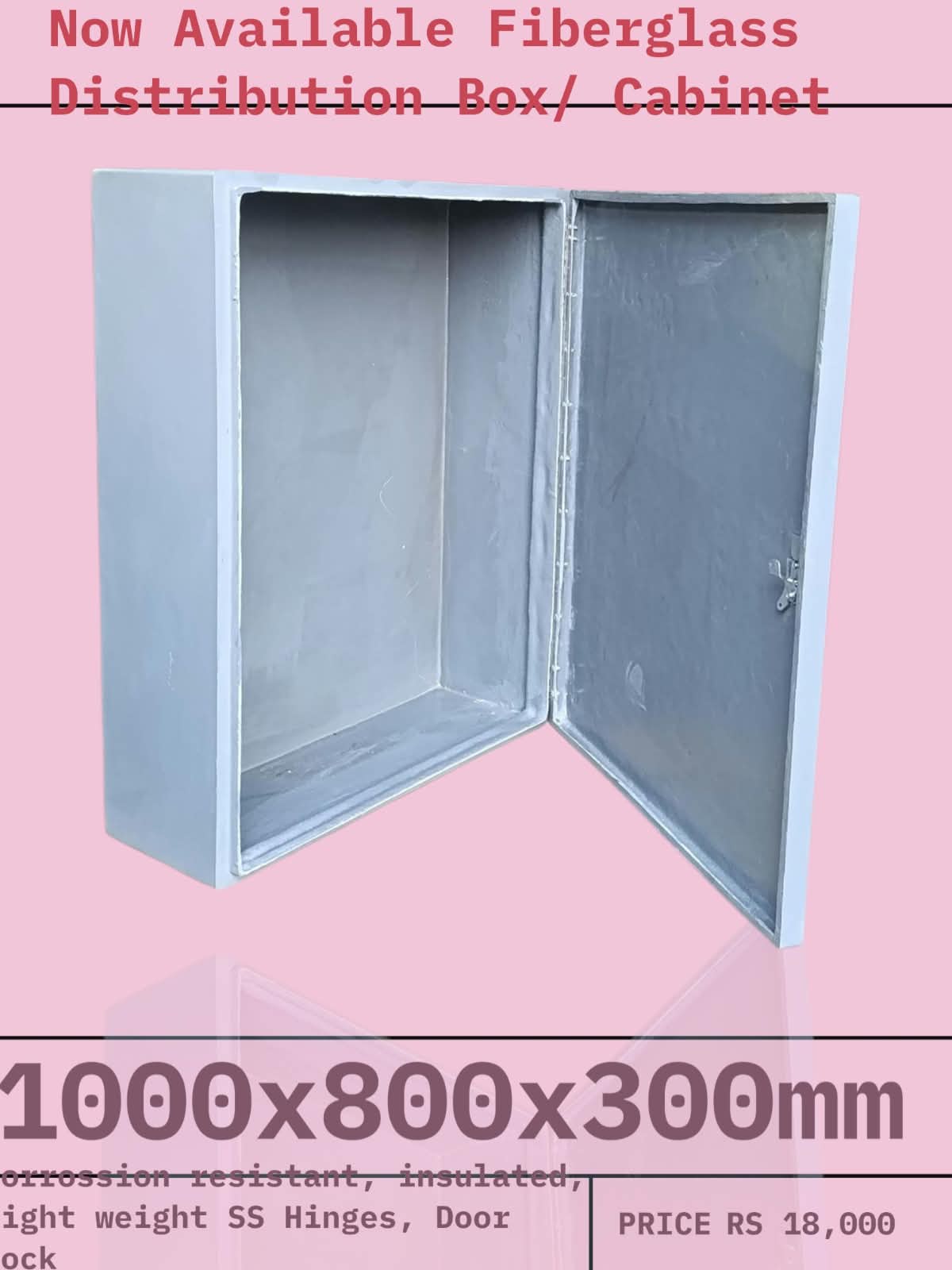
DB